
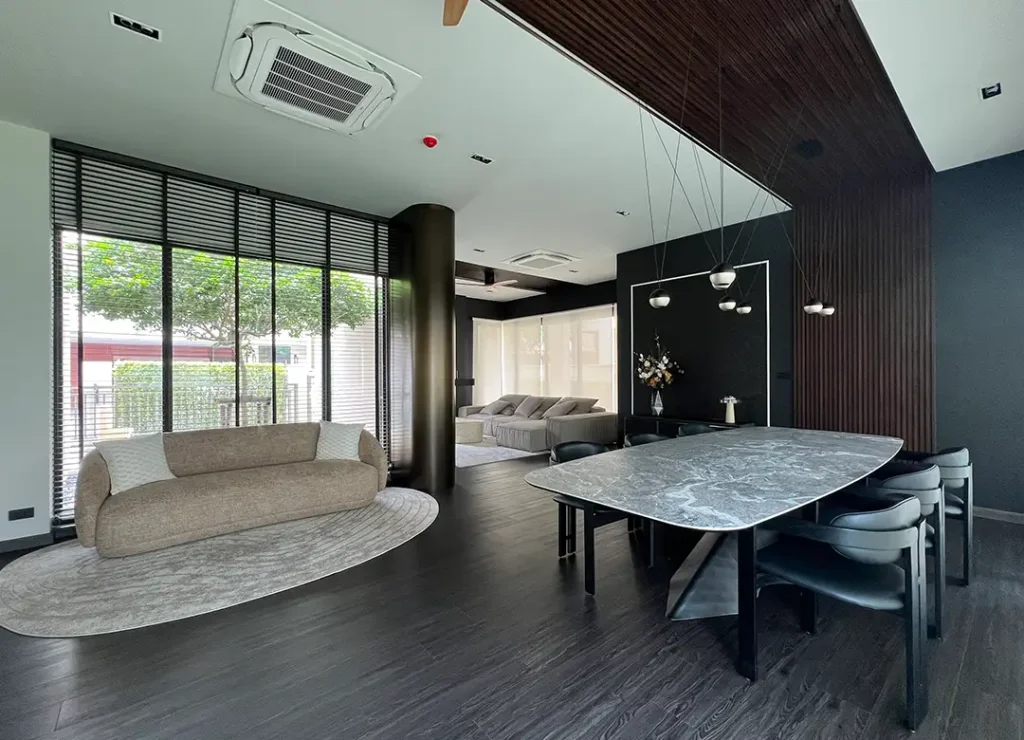
Scroll through social media or open a design app, and within seconds you will find AI tools generating photorealistic room renders from a simple text prompt. With a click, an algorithm can construct a sleek minimalist kitchen or a dramatic master suite, leading many homeowners to question whether digital tech can replace professional turnkey interior design in Bangkok. While these tools offer quick visual inspiration, transforming a physical space into a luxury residence requires far more than automated pictures.
1. Design Is More Than Beautiful Images: The Reality Gap
The fundamental flaw in assuming AI can replace interior designers is confusing a digital picture with a completed space. An AI render is merely a static arrangement of pixels generated without any understanding of physics, architectural rules, or material science.
A digital render created by an algorithm does not account for:
-
Structural Feasibility: AI does not know if a load-bearing wall can be moved, whether plumbing can be rerouted through concrete slabs, or if ceiling heights accommodate integrated HVAC systems.
-
Material Sourcing & Practicality: An AI render might generate a striking wall panel or marble pattern, but that material may not actually exist in the real world or be practical for daily use.
-
Proportions & Ergonomics: AI renders frequently feature impossible dimensions—tables with no clearance for chairs, or floating elements with no structural anchor points.
Real interior design is not about creating a digital picture; it is the art and science of turning a vision into a livable, physical reality. An algorithm can produce thousands of impressive images, but it cannot step into the real world to build what it drew.
2. The Human Element: Active Listening, Lifestyle, & Empathy
At its core, residential interior design is an intensely personal process. A home is not a showroom; it is an environment built around the unique lifestyle, daily routines, and sensory preferences of the people who live there. Artificial intelligence lacks empathy, emotional intelligence, and the capacity for genuine human listening.
Understanding Lifestyle Nuance
When a designer sits down with a client, the conversation goes far beyond a style preference like “modern” or “classic.” A human designer listens for the unspoken details:
-
How your family transitions through the home during a hectic morning.
-
How you balance open, social spaces with private areas for rest or focused work.
-
Specific acoustic considerations, mobility needs, or tactile sensitivities that dictate material choices.
Deciphering Conflicting Tastes
In many projects, partners or family members have opposing tastes. One may prefer sleek contemporary minimalism, while the other wants warm textures and classic warmth. AI cannot navigate complex human dynamics or mediate conflicting tastes. A human designer acts as an empathetic guide, harmonizing contrasting preferences into a balanced concept where everyone feels represented.
Emotional & Sensory Experience
Humans experience spaces through touch, sound, temperature, and light. A designer considers how a textured fabric feels underfoot, how custom woodwork absorbs sound in a double-height room, or how natural light shifts throughout the day. AI cannot feel, and therefore it cannot design for the human experience.
3. Zero Accountability: AI Cannot Take Responsibility
Perhaps the most critical reason AI can never replace a professional design studio comes down to responsibility.
An algorithm can generate a visually stunning custom joinery design, a floating bed, or a complex feature wall, but it bears zero responsibility for the outcome. It will not take the fall when a design proves unsafe, impractical, or impossible to construct.
Real-World Risk & Protection
Interior design projects involve significant financial investments and complex construction schedules. When complications arise on-site, AI cannot step in:
-
Structural Integrity: If an AI concept suggests hanging heavy elements without proper calculations, it won’t be held accountable if the structure fails.
-
Financial Protection: AI takes no responsibility for budget overruns, incorrect material orders, or site errors resulting from inaccurate dimensions.
-
Quality Control: AI cannot inspect physical shipments to verify if custom furniture matches approved finishes or arrives defect-free.
When you work with a professional interior design firm, you are hiring an accountable partner who owns the process from the initial sketch to the final handover, ensuring your investment remains protected.
4. The Unmatched Complexity of Hands-On Project Management
A compelling initial concept represents only about 10% of a complete interior design project. The remaining 90% relies on rigorous project management—a dynamic discipline that artificial intelligence is incapable of executing.
1. AI Capability (10% of Value)
-
Mood Boards
-
Quick Renders
-
Color Concepts
2. Human Creative Vision (45% of Value)
-
Client Empathy
-
Bespoke Joinery
-
Material Tests
3. Human Execution (45% of Value)
-
Site Oversight
-
Trade Management
-
Quality Control
Multi-Trade Supervision
Building a luxury interior requires coordinating electricians, plumbers, masons, carpenters, and painters. A designer must physically oversee site progress to ensure every trade builds precisely to engineering plans. AI cannot stand on a construction site, review millwork shop drawings with a master carpenter, or verify tile alignment.
Real-Time Site Problem Solving
Opening up walls or preparing floors often reveals unexpected site constraints—hidden structural columns or uneven surfaces. A human interior designer adapts instantly, developing creative site solutions that preserve the design intent without causing major delays.
5. Data Generation vs. True Human Creativity
AI algorithms operate by parsing massive databases of existing images, recognizing patterns, and reassembling those elements into new combinations. AI does not create anything new; it recalculates what has already been done.
Because AI relies on historical internet data, its outputs quickly become formulaic and repetitive, leading to carbon-copy spaces that lack personal identity. Human creativity, by contrast, is subtle and intuitive. Professional designers intentionally combine unexpected textures, custom furniture, and architectural elements to create unique environments tailored specifically to you.
Conclusion: A Tool, Not a Replacement
Artificial intelligence is simply another digital tool—much like CAD software or 3D rendering programs. It can assist with rapid initial ideation, but its utility ends at the screen.
Translating a design into an enduring, high-end environment requires human empathy, deep active listening, original artistic vision, rigorous project management, and absolute accountability. When you choose to work with a professional interior design studio, you aren’t just paying for a picture—you are investing in peace of mind, flawless execution, and a living space crafted specifically for your life.
Bring Your Vision to Life with Elementi Interiors
At Elementi Interiors, we understand that turning an inspiring concept into an extraordinary home takes far more than digital renderings—it demands meticulous craftsmanship, personal dedication, and seamless execution.
As a premier interior design studio in Bangkok, we offer complete, turnkey design and project management services tailored to luxury residences, condominiums, and private villas. From initial architectural spatial planning and bespoke joinery design to rigorous daily site supervision, multi-trade coordination, and final styling, our team takes complete responsibility for every detail of your project.
We handle the complexity, manage the unexpected, and deliver refined, bespoke interiors built around your unique lifestyle—on time and to the highest standards.
Ready to transform your space into a high-end physical reality?
Contact Elementi Interiors today to schedule a private design consultation for your Bangkok property, and let us bring your vision to life with precision and accountability.

