

The Cost of Compromise: Authenticity vs. Imitation in Luxury Spaces
In the pursuit of drafting a highly personalized, sophisticated home, furniture selection is the ultimate defining factor. However, the modern market is saturated with “replica” furniture—unauthorized imitations of iconic, mid-century modern and contemporary designs. While these replicas promise the visual silhouette of legendary pieces at a fraction of the cost, they often introduce severe compromises in material integrity, structural longevity, and spatial weight. For a truly elite residential project, understanding the true value of authentic furniture is key to creating a space that commands lasting value.
Consequently, while replica furniture is often marketed as a budget-friendly way to achieve a “designer look,” navigating this landscape requires a careful eye…
The Era of Functional Modernism
The late 19th and early 20th centuries marked a revolutionary shift away from the elaborate, heavily carved Victorian and Renaissance styles. Architects and designers began championing simplicity, versatility, and structural honesty. This was the birth of modern furniture—where form directly followed function. Visionary designers began experimenting with industrial materials like tubular steel, molded plywood, and structural leather, creating lightweight, visually airy masterpieces that defined contemporary living.
In modern furniture, you will see clean and simple designs.
Eero Saarinen designed the famous Tulip chair.
According to him:
“I wanted to clear up the slum of legs. I wanted to make the chair all one thing again.”

The Eames Lounge Chair by Charles and Ray Eames is a timeless piece. You may have seen it in movies and screenplays. Egg chair is another state-of-the-art chair by Arne Jacobsen.

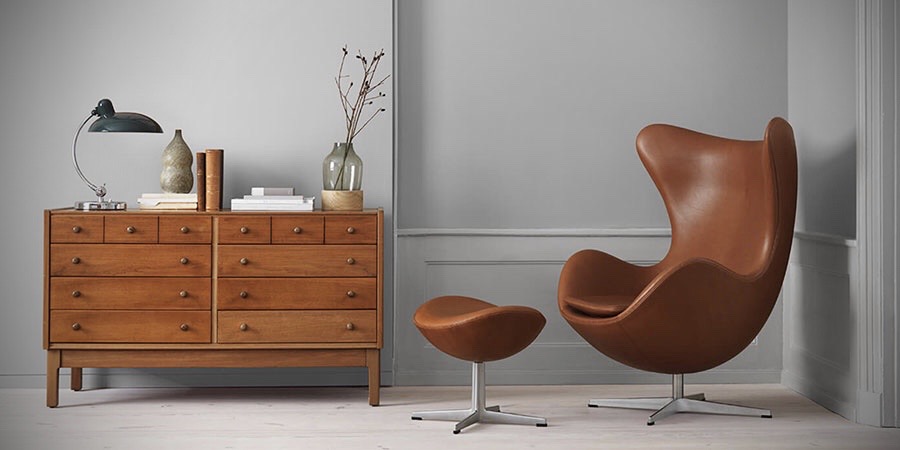
The design of modern furniture is a great “win-win”. First, it provides both aesthetics. Secondly, it offers great functionality. In short, futuristic designs became more popular and are still in trend today.
The Evolution of the Replica Market
In the mid-2000s, copyright protections for many iconic mid-century furniture designs expired in certain European regions, most notably in the UK. This regulatory shift opened the door for manufacturers to replicate historic designs legally. Initially, premium replica producers attempted to maintain the exact dimensions and material weights of the original designs.
However, as production shifted toward high-volume, mass-manufacturing hubs across Asia, the focus quickly transitioned from quality craftsmanship to cost-cutting. Today, the market is flooded with low-grade imitations that look acceptable in online photos but fail completely upon physical contact, often utilizing lightweight hollow metal, unstable foam padding, and low-durability synthetic fabrics.
The Masters of Modernist Form: Pioneers of Iconic Furniture Design
To truly appreciate the integrity of iconic furniture, one must look directly at the visionaries who originally drafted them. The masterpieces that are frequently replicated today were not just random products; they were highly calculated architectural statements created by the legendary figures of 20th-century design.

Le Corbusier
Chaux-de-Fonds, 1887 – Cap Martin, 1965
Le Corbusier is one of the most well-known architects of the 20th century.
He realized that the new times needed a new approach and new methods of manufacturing. Consequently, his approach centered on both function and aesthetics.
Firstly, there were new trends in society. Secondly, the materials and methods of production had changed a lot. Therefore, Le focused on a new approach to designing and manufacturing.
He revamped the existing conventions in architecture and furniture. As a result, he created exquisite pieces that were functional and artistic at the same time.
All seats from Le Corbusier are still regarded as a breakthrough in the world of interior design.

Ludwig Mies Van der Rohe
Aquisgrana, 1886 – Chicago, 1969
Mies van der Rohe is one of the most prestigious interior designers of the 20th century. He is well-known for his chair designs.
You will find simple and functional chairs and luxurious and comfortable ones. His unique designs have dominated the world of design.
For instance, the cantilever chairs are the best example of simple chairs. Likewise, the deluxe Barcelona chair is another feather in his cap. His designs rank equal with the likes of Charles Eames.
In his designs, you will find great attention to detail. Moreover, he focuses on creating a feeling of space. This reflects his approach to architecture.
In addition to all his creations, the Barcelona Chair is a classic known for its luxurious design. It is also regarded as the status symbol of this time.
Marcel Breuer
Pecs, 1902 – New York, 1981
The pioneer of tubular chair design, Marcel Breuer was a prestigious designer.
In early 1925, he invented a new system of making the frames of stools, chairs, and tables. His system focuses on using bent steel tubes for the structures of chairs.
The first chair of this series was the ‘Wassily’ chair. Certainly, it is still in great demand and is considered a classic in the world of interior design.
The ‘Wassily’ chair presented a great spatial solution and aesthetic influences. However, he shifted his focus. Marcel emphasized the practical value of the furniture. After that, he became interested in the standardization and mass-production of furniture.
Eero Saarinen
Kirkkonummi, 1910 – Ann Arbor, 1961
Son of a celebrated Finnish architect, Saarinen is another famous designer. He studied in Paris at the Académie de la Grande Chaumiére.
Saarinen also went to Yale University in New Haven, Connecticut.
Eero Saarinen collaborated with Charles Eames and made many advanced and award-winning furniture designs. The designs were exhibited at the “Organic Design in Home Furnishings” competition. It is a famous competition at the Museum of Modern Art in 1940.
He also designed many exclusive pieces for Knoll International. For instance, the terminal at John F. Kennedy Airport, New York, is one of his most popular creations.

Eileen Gray
Brownswood, 1878 – Paris, 1976
Eileen Gray was an imaginative interior designer who revolutionized the world of furniture. Between WWI and WWII, she worked in Paris. In the late 1920s and early 30s, Gray made prototypes of many chairs.
Her designs focus on functionality and aesthetics. She designed a chair with upholstery on the chrome-plated frame of tubular metal.
Gabriele Mucchi
Torino, 1899 – Milano, 2002
Gabriele Mucchi was a professor in the School of Art in Berlin. Above all during the 1930s, Mucchi was one of the biggest proponents of the Realist Movement in Italy. In that time, there were other prestigious architects like:
- Roger
- Albini0
- Zanuso
- Bottini
- Lingheri
- Terragni
He worked with Bottini to plan the QT8 in Milan. He worked as a teacher and as a painter.
His first exhibition was in 1983 in Berlin and Moscow. This followed another successful exhibition in Magdeburg (East Germany) in 1987.
Harry Bertoia
San Lorenzo di Arzene, 1915 – Barto, USA, 1978
After leaving Italy at the age of 15, Bertoia found his passion for painting and sculpture. He joined the Detroit School of Arts and Crafts, and then the Cranbrook Academy of Arts.
Bertoia started designing furniture in the 1940s. Harry designed chairs with sculptures. His unique style gave them a metallic and colorful quality. Therefore, they are still famous all over the world.

Josef Hoffmann
Pirnitz, 1870 – Wien, 1956
Josef Hoffmann was an Austrian architect and designer.
For a short time, he worked with Otto Wagner in his studio as his pupil (1895). Hoffmann also worked as a co-founder of the Vienna Secession (1987) and the Wiener Werkstätte (1903).
In his work, you can see the influence of Wagner as well as Charles Rennie Mackintosh. He takes inspiration from rationalism from Wagner. And, from Mackintosh, he borrows a rectilinear and geometrical style.
For instance, at Wiener Werkstätte, you will view the best of Hoffman’s work. His designs have individuality and craftsmanship. In his work, he stays true to materials and functionalism. These are the dominant features of his work.
Gerrit Rietveld
Utrecht, 1888 – Utrecht 1964
In 1918, Rietveld designed his popular Red/Blue chair. The red/blue chair was an innovative idea. He used machinery and linear materials to produce spatial chairs.
The chair shows a unique geometrical design paired with vivid colors. You will see a prominent influence of De Stijl painters. Certainly, it also shows the artist’s inspiration from the Berlin chair and the Military series.
In Rietveld’s work, you can see aesthetics with smart production. That is to say, he made beautiful economic designs.
Isamu Noguchi
Los Angeles, 1904 – New York 1988
Isamu Noguchi is an American sculptor. He had the privilege of studying under Brancusi in Paris. His father was a Japanese poet, and these roots dictated his style.
The Noguchi style takes inspiration from European modernism and Japanese traditionalism. In his works, he couples contrasting elements. Like, roughness and smoothness, and geometry and animation.
Above all, he used all kinds of materials like stone, wood, and metal. Noguchi coupled natural materials with his unique style to design exquisite pieces. His work gained popularity in sculpture, abstract sculpture, and architecture.
Noguchi’s abstract pieces adorned architecture. For instance, the red cubes in the Marine Midland Bank (New York), and the entrance of the Museum of Modern Art (Tokyo).
Other things that he is famous for are playgrounds and gardens with stone sculptures. For example, the UNESCO Garden in Paris and Mexico City.
In addition, he also designed amazing stage sets and props for the Marth Graham Dance Company. Noguchi’s list of contributions consists of modernist classics. You will see home decorations like glass-top coffee tables and paper lanterns.

George Nelson
Hartford, 1908 – New York, 1986
George Nelson was a modernist. He is popular in the fields of interior, industrial and exhibition design. A Yale graduate, Nelson gained popularity as a writer on design. He wrote for Architectural Forum, Interiors, and Fortune.
In 1945, in Michigan, Nelson joined the Herman Miller Furniture Company. There, he served as a head designer and developed an innovative line of furniture.
In addition, he also commissioned the designs of other famous designers :
- Isamu Noguchi
- Charles Eames
- Herman Miller
Moreover, he collaborated with R. Buckminster Fuller for creating many fabulous projects.
Some of his most significant contributions include:
- bubble lamps
- ball clock
- marshmallow sofa
- pole-supported wall-storage system.
Charles Rennie Mackintosh
Glasgow, 1868 – London, 1928
Charles trained at the Glasgow School of Art. Charles Rennie Mackintosh worked with John Hutchinson.
His work shows the shift from the influence of Art Nouveau to geometric Modernist purism. Mackintosh’s designs include some of the most incredible pieces of British furniture.
Mart Stam
Purmerend, 1899 – Zürich, 1986
Mart Stam is well-reputed for designing chairs with unique designs. However, his popularity rests exclusively on one design – the S33. The S 33 is the first tubular steel, cantilever chair.
How he stumbled on the idea when designing a chair for his wife. He wanted to make a chair with straight lines of tubes and gas fitter joints.
The innovative idea became popular and introduced new methods of designing chairs.
Wilhelm Wagenfeld
Bremen, 1900 – Stuttgart, 1990
This designer is known for his numerous incredible objects. His creations have become a part of every home decoration.
Some of his designs include everyday items. Like the Max and Moritz salt and pepper holders, or a unique ink bottle with a bent neck.
In 1954, Wagenfeld opened a research laboratory. The laboratory focused on manufacturing industrial design projects. He worked with glass to design fascinating plates, vases, lamps, and glasses.
Wagenfeld also experimented with other materials. This included things like metals to make tables, candlesticks, and hardware.
He has written various articles and books to express his ideology of design. Wagenfeld has also received many prizes for his contribution to the world of design.

The Value of the Original: Why Quality is the Ultimate Interior Investment
Choosing original design and custom-engineered furniture over mass-produced imitations is not simply a matter of prestige—it is a practical investment in the longevity and atmosphere of your home.
-
Tailored to Your Space: Unlike standardized replicas that must fit into a box for shipping, bespoke custom furniture and custom joinery are designed to fit the precise millimeter dimensions of your unique layout. For example, integrating beautifully crafted custom corner wall shelves is a seamless way to maximize an awkward corner while maintaining the room’s architectural integrity.
-
A Healthy Living Environment: High-end manufacturers and custom artisans use certified, non-toxic finishes, sustainably sourced timber, and natural oils. Cheap replicas frequently rely on off-gassing adhesives, formaldehyde-heavy MDF, and synthetic coatings that compromise indoor air quality.
-
The Unmistakable Feeling of Luxury: A space styled with authentic, beautifully crafted pieces feels grounded, quiet, and timeless. True luxury is felt in the weight of a solid timber table, the smooth glide of a soft-close custom drawer, and the flawless texture of authentic grain.
How to Recognize True Furniture Craftsmanship
When curating your home, assessing the construction quality of furniture is essential—especially when trying to distinguish a cheap, mass-market imitation from a high-quality, investment-grade piece. True luxury furniture, whether a licensed designer classic or a bespoke custom-made commission, will always reveal its quality in the structural details.
When inspecting furniture for your project, pay close attention to these three hallmarks of superior craftsmanship:
1. Mathematical and Proportional Precision
The pioneers of modern design spent years perfecting the exact proportions of their creations to balance structural load with clean lines. Low-end replicas almost always miss these nuances, resulting in proportions that look clunky or feel off-balance. When evaluating a piece, cross-reference its dimensions with the designer’s original blueprints. True premium pieces will respect these exact ratios to a millimeter.
2. Material Authenticity and Weight
Premium, high-end furniture has an unmistakable physical presence and weight.
-
The Steel: Look for solid, heavy-gauge steel frame components—ideally seamlessly welded and polished to a mirror finish. Avoid lightweight, hollow-tubing replicas that bend or wobble under pressure.
-
The Wood: True luxury pieces utilize solid hardwoods with beautiful, continuous grain matching. Be wary of paper-thin, poorly glued veneers that chip easily.
3. Flawless Upholstery and Joinery
Inspect the seams, piping, and joinery. Elite upholstery features tight, perfectly straight stitching, even tension across curved panels, and premium, natural top-grain leathers that smell clean and feel buttery soft. Low-grade imitations rely on chemical-heavy PU leathers, sloppy staples, visible glue trails, and mismatched screws that compromise the piece’s integrity.

Replica Furniture: Final Thoughts
Ultimately, your home should be an authentic reflection of your personal story, values, and appreciation for fine design. While the lower cost of replica furniture can seem tempting on paper, the physical reality of living with imitation pieces rarely delivers the warmth, comfort, and sensory satisfaction of a truly premium interior. By surrounding yourself with original design, meticulously engineered custom joinery, and natural materials, you create an inspiring, timeless environment that only grows more beautiful with age.
Sourcing authentic furniture classics or crafting bespoke pieces tailored perfectly to your layout is an investment in your daily lifestyle.
Begin Your Design Journey with Elementi
If you are planning a premium residential renovation or condo fit-out in Bangkok and want to ensure every piece of furniture, joinery, and lighting aligns with uncompromising luxury standards, let’s connect.
-
Direct Consultant: Nicola Conti
-
Phone & LINE: +66 (0) 81 274 9892 (LINE ID:
nicolaconti) -
Inquire Online: Connect with us via Elementi Interiors or visit our main contact page to schedule a private design consultation.

